
Your billing team verified the patient’s insurance. The authorization went through. The care was delivered. And then, weeks later, a recoupment notice or denial arrives because the patient’s Marketplace premium delinquency was not resolved during the grace period.
This scenario plays out at hospitals across the country, and many revenue cycle teams only discover the problem after the damage is done. ACA Marketplace plans include a 90-day grace period for members who fall behind on their premiums. During that window, coverage may still appear active in eligibility systems while the insurer waits to see whether the patient resolves the delinquency. If they do not, claims from the second and third months may be denied or, in some cases, subject to recoupment. While issuers are required to notify providers of the possibility of denied claims during this period, those notices can still be difficult for revenue cycle teams to track and act on consistently.
For revenue cycle leaders managing high volumes of Marketplace accounts, the financial exposure can be significant. Inpatient stays, oncology treatment, and other high-cost service lines are particularly vulnerable. The good news is that some of this revenue loss can be reduced, but only if your team can identify the risk early enough to act.
What Is The ACA Marketplace Grace Period And Why Does It Create Risk For Hospitals?
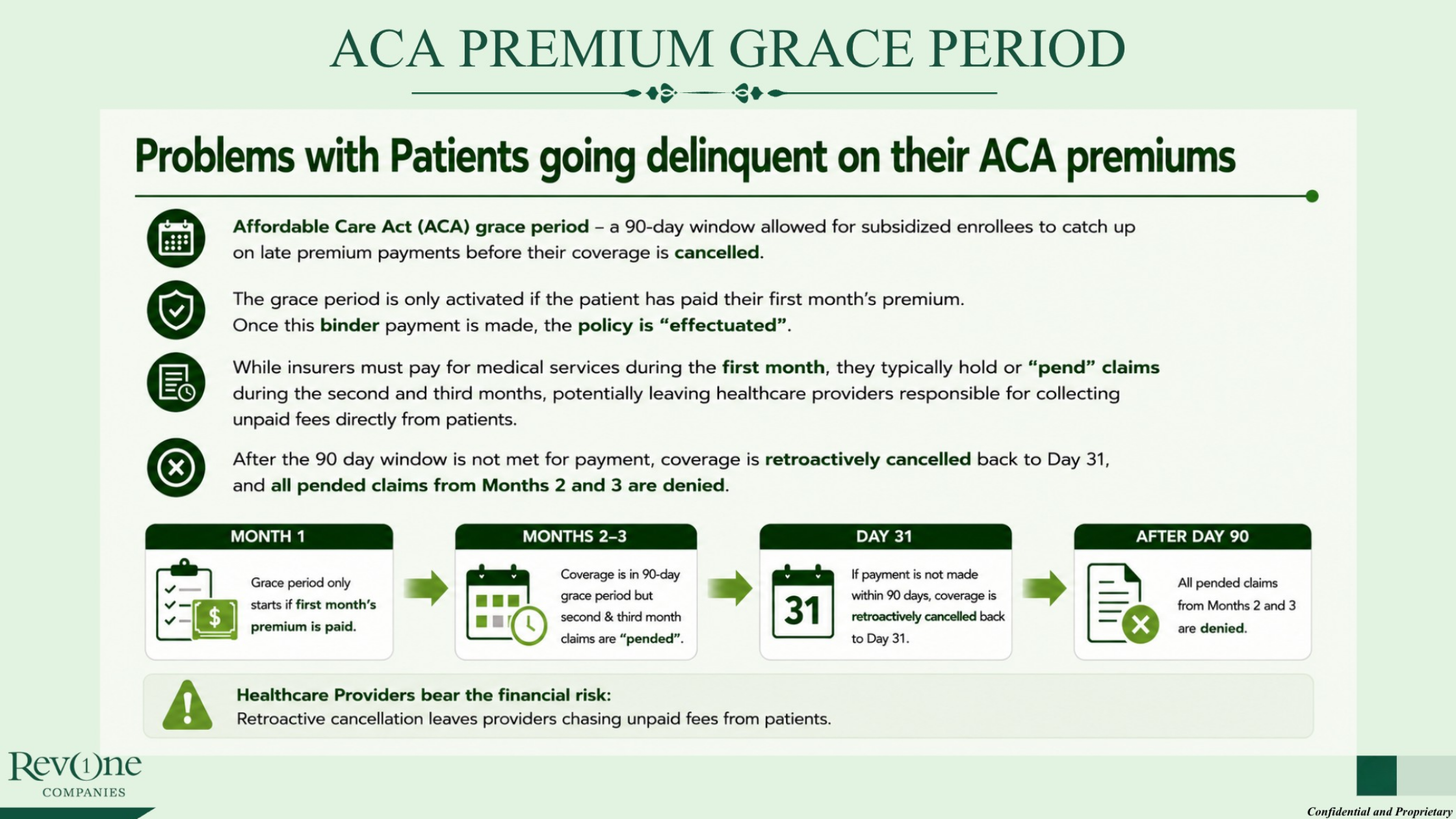
Under the Affordable Care Act, Marketplace plan members who receive advance premium tax credits generally have a 90-day grace period if they fall behind on premium payments after coverage has been effectuated. During the first 30 days of that grace period, the insurer is required to pay appropriate claims. During days 31 through 90, the insurer can pend claims, meaning they are held and not paid while the delinquency remains unresolved. If the member does not pay their past-due premiums by the end of the 90-day window, coverage can be terminated retroactively to the end of the first month. Claims for services in months two and three may be denied, and any claims from that period that were paid may be subject to recoupment.
The core problem for hospitals is a data gap. Standard eligibility verification systems may still return an “active” status, or may not clearly surface actionable grace-period risk, for a patient in the 31-to-90-day pend window. Your team may not reliably see that the coverage is at risk unless you have a process in place specifically designed to capture and act on grace-period or premium delinquency indicators.
This matters most for high-cost, high-exposure cases. An inpatient stay, a course of chemotherapy, or a complex surgical procedure can generate tens of thousands of dollars in claims, creating significant exposure if coverage terminates retroactively or claims from the pend period are denied.
What Happens To Your Claims When A Patient Is In Premium Delinquency?
Understanding the mechanics of the grace period helps clarify exactly where your revenue is exposed. When a Marketplace member enters delinquency, the following sequence typically unfolds:
During the first 30 days, appropriate claims are processed and paid as normal. There may be no clear external indicator that anything is wrong. Your team bills, the insurer pays, and the account appears healthy.
Between days 31 and 90, the insurer may begin pending claims. These claims are not denied outright, but they are not being paid either. In some cases, previously adjudicated claims from this window may be held for potential recoupment. Your billing team may see delays in payment without a clear explanation.
If the member does not resolve their premium delinquency by day 90, their coverage can be terminated retroactively. Claims paid during the pend window may be subject to recoupment. Claims not yet adjudicated may be denied. The hospital may be left holding the balance for care that was delivered in good faith.
The administrative burden compounds the financial loss. Your team must now identify affected claims, process the recoupments, appeal where possible, determine whether the patient qualifies for alternative coverage, and resubmit clean claims if coverage is restored. Each of those steps takes staff time and delays cash flow.
Which Patients And Service Lines Are Most At Risk?
Not every Marketplace account carries the same level of delinquency risk, but certain patient populations and service lines create disproportionate exposure.
Patients with variable or seasonal income are more likely to fall behind on premiums during periods of lower earnings. Patients who enrolled in Marketplace coverage with the help of a navigator or enrollment advocate, but who may not fully understand the monthly premium obligation, are another common risk group. Patients who have had prior coverage gaps or who enrolled late in a plan year also warrant closer attention.
On the service line side, inpatient admissions are the highest-priority concern. The financial exposure on a single inpatient stay can be substantial, and a retroactive termination on that account creates immediate, significant revenue loss. Oncology is similarly high-risk, given the ongoing, multi-visit nature of treatment and the high dollar value of individual claims. High-cost outpatient procedures and emergency visits are also worth monitoring, particularly when the patient has a pattern of Marketplace coverage instability.
For many health systems, a relatively small number of high-exposure accounts represent the majority of potential delinquency-related losses. Prioritizing monitoring and outreach for those accounts first is one of the most effective ways to protect your revenue cycle.
How Does Proactive Delinquent Premium Monitoring Works?
Reacting to recoupments after the fact is expensive and time-consuming. A proactive monitoring program is designed to catch premium delinquency in real time and give your team the window needed to address the situation before coverage terminates.
Effective delinquent premium monitoring starts with daily eligibility verification specifically designed to detect grace-period status. Standard eligibility checks may not surface this information reliably, which is why a dedicated monitoring workflow is necessary. By reviewing Marketplace accounts daily against payor data, you can identify which patients may currently be in delinquency before claims are pended, denied, or recouped.
Once at-risk accounts are identified, structured patient outreach is the next step. Contacting the patient to explain the situation, confirm their status, and walk them through their options gives them the opportunity to resolve the delinquency before coverage lapses. In some cases, patients are unaware that their premiums are past due. A single phone call or message can prompt them to make a payment and preserve their coverage, protecting both their continuity of care and your claims.
When premium resolution is possible, catch-up payment support helps facilitate the process. After coverage is confirmed as active, clean claim submission and resubmission can proceed with greater confidence. Throughout the process, clear account-level reporting keeps your revenue cycle team informed of where each case stands and what action, if any, has been taken.
What Does Delinquent Premium Monitoring Protect Against?
The most direct benefit of a delinquent premium monitoring program is reducing the risk of recoupments on claims that have already been paid. Retroactive termination is the worst-case outcome of unresolved premium delinquency, and early identification can give the hospital and patient a better chance to resolve the issue before claims are denied or recouped.
Beyond recoupments, proactive monitoring can reduce the volume of pended claims sitting in your accounts receivable with no clear resolution path. Pended claims tie up cash flow, create uncertainty in your revenue projections, and generate rework when they eventually deny or pay. Resolving the underlying delinquency can help get those claims moving again.
Delinquent premium monitoring also supports continuity of care. When coverage is preserved before it lapses, patients may be able to continue receiving treatment without interruption. That matters for your patients, and it matters for the clinical teams managing their care. Coverage gaps that occur mid-treatment are disruptive for everyone involved and often result in delayed care that creates additional financial and operational complexity down the line.
Finally, reducing preventable bad debt tied to coverage lapses improves the overall financial health of your Marketplace portfolio. Some claims that might otherwise become write-offs due to retroactive termination may remain recoverable when delinquency is caught and resolved in time.
Is Your Team Currently Equipped To Catch Premium Delinquency?
For many hospitals, the honest answer is no, not without a dedicated program in place. Standard eligibility verification is designed to confirm whether a patient has coverage on a given date. It is not designed to reliably flag delinquency status within an active grace period. Many revenue cycle teams do not realize they have a delinquency monitoring gap until they begin seeing recoupment notices or investigate why a cluster of Marketplace claims has not been paid.
If your organization has a significant volume of ACA Marketplace patients, particularly in service lines like inpatient and oncology, it is worth evaluating what your current workflow catches and what it misses. Questions worth asking include: How quickly would your team identify a patient who entered the grace period yesterday? What is your process for following up on pended Marketplace claims? How many Marketplace-related recoupments has your team processed in the last 12 months?
The answers to those questions will tell you a lot about your current exposure.
Conclusion
ACA Marketplace premium delinquency is one of the more preventable sources of revenue loss in hospital billing, but only if you have the infrastructure in place to catch it early. The 90-day grace period creates a narrow but critical window in which proactive monitoring, patient outreach, and premium resolution can help protect claims that would otherwise be recouped or denied.
Revenue cycle leaders who build a delinquent premium monitoring program into their Marketplace strategy are not just protecting individual claims. They are protecting the financial integrity of their Marketplace portfolio and reducing the administrative burden that comes with reactive claim recovery.
If your team is managing ACA Marketplace patients without a dedicated delinquency monitoring workflow, now is the right time to close that gap. Complete our interest form to connect with RevOne’s team and learn how Delinquent Premium Monitoring can be built into your existing revenue cycle operations.